who occupies a stochastic rate that quickly gets an intuitive understanding of random variables. My experience was that I quickly had an intuitive understanding to solve simple exercises could, and later suffered greatly from not having a mathematical understanding of a random variable. My girlfriend is currently preparing for exam students and I see my old mistakes again in their students: it is possible to operate without understanding stochastic random variables, but then later concepts are difficult. I hope that after this article, the interested reader can do both: the definition of formal proofs without using intuition to lose for chance to bring every student:).
A random variable is a function. A what? Yes, exactly. Also a deterministic and somewhat unexpected and not a bit random. It's pretty maps no matter which room in which room the random variable. I choose you an example: hot
Our random variable X . The random variable X forms of space
A = {1,2,3}
in the room
B = {W, L}
from. Here W is a walrus and L is a leopard. What I mean is: random variables operate in areas, which need not be algebraic. A random variable can map anything to anything.
random variables, we can examine an example of good. We definierne X as follows:
X (1) = W , X (2) = W , X (3) = L .
But where is there by chance? There is none. Stochastics is pure mathematics, mathematics of functions on spaces and their properties. The rooms are particularly well suited to so real, random to describe events. If you do that it runs statistics. In our example, I could claim to illustrate that A the goals in a game show are B are the things that can be found behind the gates. But the situation would not add anything.
What really does is measure of probability. You need for every room A and B still a tape measure with which we can measure a subset ⊂ A and b ⊂ B . We say "likely", but in truth we measure only. By that I mean, you are the size. As with a ruler. If Stochastics say that the probability is 1 / 3! Then they think: I took a ruler and measured, and it is 1 / 3 size. For the general confusion, we call this scale "probability", although it again nothing happens.
I define now a tape measure for A , but none for B (later, we are looking for a tape measure B, I promise). I call my tape measure P . And I say P ({1}) = 1 / 3. P ({2}) = 1 / 3. P ({3}) = 1 / 3. P is the uniform distribution on A . Perhaps an eagle eye drops on that measure that P actually all subsets a ⊂ A may be what is, for example P ({1,2})? It is the property of tape measures that you can measure the components alone and then sum up the lengths.
P ({1,2}) = P ({1}) + P ({2}) = 2 / 3.
said, the stochastics is great in it, measure, and we have not B measured. Which, if you will, a central feature of the stochastics is that if you measure A can and there is a random variable of A after B has , then we can build a measure of B . Stochastic description of this scale derived by a notation that seems only to invent a completely different look than the rest of mathematics. They write things like P (X = L). What do you mean? (Most students help themselves by understanding the metaphorical expression, and read: "probability that X = L") I use a more common notation, and then explain the Stochastikernotation later.
Ok, we seek a measure of B . We have P, which is the measure of A , and We have X, the random variable. I propose that as a measuring tape to B
 function. The -1 in the exponent means inverse function (see, eg here), the circle means "after" and I mean only
  .
. order for us to understand the situation better we calculate
. X -1 ({W}) are all pre-images of walrus, that is
X -1 ({W}) = {1,2}.
And so
 ,
, and analog
 .
. Our goal was, a tape measure for B to have, we have achieved it? There are two important criteria for a good tape measure in stochastics. Since they are called "probability measures". The first is:
- If you measure the whole space, we obtain as a result
what we have achieved in our example, because 2 / 3 + 1 / 3 = 1 It applies to all variables on probability measures induced, and I recommend the reader to prove that, it's really easy:).
The second is:
- If we measure something, we can also use it just as well cut up into parts, measure the parts and their sum must give the whole
Wikipedia expresses something less prosaic like this:
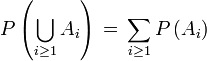 with A i pairwise disjoint.
 And here one would have to go back a bit further, I was only a short version: It is a sad reality of mathematics, probability spaces that you can not cut up as desired. In our rather small probability spaces, everything is still fun and possible, but exclude even at only slightly more complicated spaces must be the most mathematically possible sawing up to meet the first criterion. So one has to find a probability space and allowed to specify a list of his sawing. This list of allowed sawing is called the "σ-algebra" of the probability space. The σ-algebra of some probability space C thus contains only the subset of C that can we measure it.
And now we can finally explain what a probability variable:). A function X : A → B a probability variable is when you can generate from it a probability measure on B. Why should not that be possible? Now, if X regarding the σ-algebras "incompatible" is.
For example, let's assume we know a probability measure on A , namely P .
Then we would like to see
is a probability. Why should this be? Well, X -1 could have a picture that is not a valid argument for P (Gülten arguments are valid for P "sawing" of A , and those are elements of the σ-algebra to A ). And this is really all the magic. We require that X -1 , valid sawing B to valid sawing A maps. Or formalistic, the calligraphic A is the σ-algebra A to is the calligraphic B the σ-algebra B to :  . What should a
 notice is that this condition is fairly mild. You have to go pretty far to find a function that satisfies the condition is not (although technically meet almost all the functions of the condition NOT).
Many students are confronted with this condition and think: Aha, X must be surjective! But X must be neither surjective nor injective. My Blog inclined reader has learned that the condition expresses the compatibility the σ-algebras of, nothing else.
It is still open, our notation is difficult to type and write. And therefore, the stochastics have devised a special notation that goes against all conventions of mathematics, but much shorter than mine and so popular:

Well, and also is the spelling suggestion. P ( X = b ) to read to you as: The probability that X = b, which sounds cool, and fits well into the intuition about probabilities, but it fits just not as good for defining the world of stochastics not in the X = b randomly is.
I hope that after this article, the interested reader can do both: the definition of formal proofs without using intuition to lose for chance to bring every student:).


0 comments:
Post a Comment